


Duct Tape Manufacturer in China: 2026 Buyer Guide
 Nov 23, 2026|
 View:5
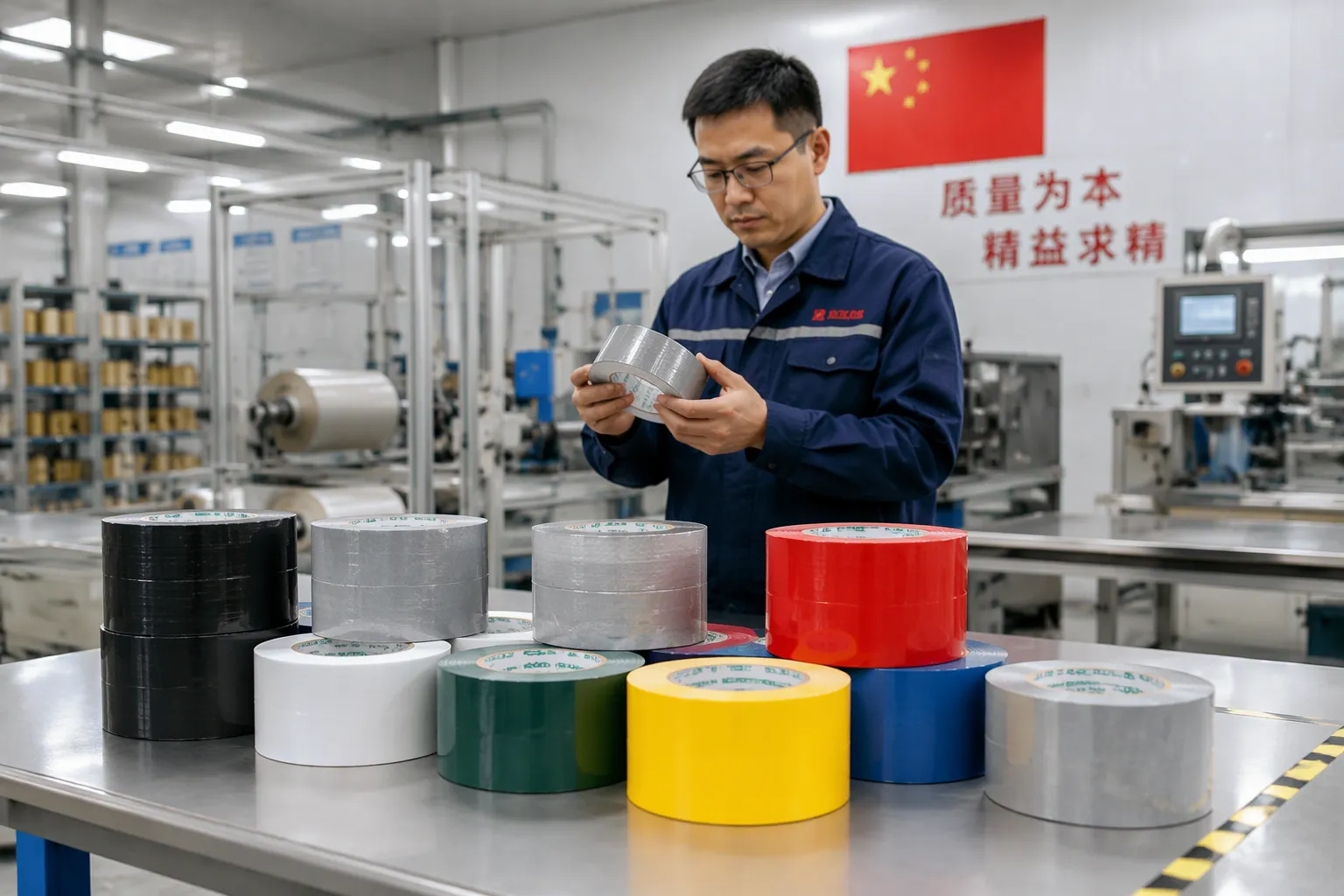
Most duct tape sourcing problems do not start with price. They start with a specification that was never written down, a certificate that expired last spring, or two temperature figures on the same product page that nobody reconciled before the container shipped. A buyer who compares quotations without pinning down those three things is comparing documents, not products.
This guide sets out how to verify a duct tape manufacturer in China before you commit: which certificates to check and where to check them, how to run a sample test in your own facility, how to read the numbers on a specification sheet, and how to compare landed cost rather than roll price. It then shows the method applied to one supplier, Gelly, with the published specifications, the product range, and the certificates as stated. Every figure quoted for that profile comes from the supplier's own published product data; where a value needs written confirmation, the text says so rather than assuming.
Key Takeaways
Application fit comes first, certificates second, and cost third. Reversing that order is how buyers end up with tape that passes on arrival and fails in month four.
Verify certificates at the source, not from a PDF attachment. A certificate number should match the manufacturer's legal name and cover the product you are buying.
Sample testing is the only step that compares published numbers against physical rolls, and it takes an afternoon rather than a quarter.
Two temperature figures usually appear on a duct tape data sheet, and they answer different questions. Confusing them is the most common specification error in cold-chain buying.
Compare cost per sealed carton or per square meter, not cost per roll. Roll price hides width, length, and thickness differences that decide how many cartons a case actually seals.
What Actually Decides a Duct Tape Purchase
The Four Criteria That Matter
Four criteria do most of the work, and they are not equally weighted. Technical performance of a duct tape covers thickness, peel adhesion, tensile behavior, and the temperature band the tape is rated for. Application fit asks whether the construction suits the job in front of you: HVAC sealing, carton closing, pipe protection, carpet joining, automotive masking, or stage work each stress a tape differently. Regulatory compliance covers the certificate file and whether the documents actually describe the product you are ordering. Cost indicators cover quoting structure, minimum order quantity, and lead time rather than a headline unit price.
The weighting changes with the buyer, and that is the part most sourcing guides skip. A contractor buying for construction cares about adhesion under load and weather exposure, and will pay for thickness. A distributor building a private-label line cares about color consistency, packaging, and paperwork, because a rejected pallet costs more than a cent per roll. Neither buyer is wrong; they are optimizing different failure modes. This is also why no single ranking of duct tape manufacturers means much on its own: the supplier that suits a 20,000-roll private-label program is rarely the one that suits a five-roll trial.
The Order to Apply Them
Apply the criteria in sequence and the shortlist sorts itself. Screen on application fit first, because a technically impressive cloth duct tape that will not survive your surface is worth nothing at any price. Check the certificate file next, since compliance failures are binary and cannot be negotiated down. Compare cost last, once the surviving options are genuinely interchangeable.
There is a practical reason for that order. Price is the easiest variable to compare and therefore the easiest to over-weight, and quotations from different duct tape manufacturers are rarely written to the same template. One quote prices a 48mm by 50m roll at a given thickness; another prices a 50mm by 40m roll at a different one. Read side by side without normalising, the two numbers look comparable when they are not. Sequencing the criteria protects you from that trap before you open the spreadsheet.
How to Verify a Duct Tape Manufacturer
Step 1: Certificates, Checked at the Source
Ask any duct tape manufacturer for certificate copies, then ignore them until you have verified them independently. Three checks catch almost every problem. First, the certificate number and the manufacturer's legal name must match the entity on the quotation and the bill of lading: a trading company quoting under a factory certificate is a common mismatch. Second, the scope must actually cover the product being bought, because a certificate issued for a different tape family does not transfer. Third, check the validity date, since certificate files outlive the certificates inside them.
For ISO 9001, the validation can be run through the international register that validates accredited certificates, which confirms whether an issuing body was accredited for that scope. For the Chinese side of the file, the national certification authority's public register covers domestic certification records. Where a supplier names an inspection body for test reports such as third-party testing and inspection services, ask for the report number and confirm it against the issuer rather than the letterhead.
RoHS and REACH sit in a different category from ISO 9001, and it is worth being precise about the difference. ISO 9001 certifies a quality management system; it says nothing about whether a specific roll meets a substance restriction. RoHS and REACH compliance are declarations about material content, usually evidenced by a test report on a specific sample. A supplier who can produce an ISO 9001 certificate and a recent test report is answering two separate questions. A supplier who offers only the first has not answered the second.
Step 2: A Sample Test You Can Run In-House
Sample testing is where a duct tape data sheet meets a physical roll, and it does not need a laboratory. Seal a carton of the weight and board grade you actually ship, leave it for the number of days your route takes, then open it and look at the adhesive side. Adhesive that has transferred to the board while the backing comes away clean points to an under-cured or under-treated construction, and no data sheet will tell you that in advance.
For a more disciplined comparison, run the standard tests rather than an improvised peel. The published test methods for pressure-sensitive tape define 180-degree peel, shear, and tack in ways that make results comparable between suppliers, which an informal pull test does not. Ask each candidate for results using the same method on the same substrate, and the numbers become a shortlist tool instead of marketing copy. Test at the temperature you will actually work in, too: a roll that performs in a warm office and fails on a cold loading dock will pass every test you run at room temperature.
Sample cycles matter more in custom work than in standard grades, because color accuracy and adhesive feel decide whether a private-label product sells. Anyone ordering custom duct tape should approve a physical sample of the exact shade before volume production, not a screen rendering and not a swatch photographed under unknown light.
Step 3: Written Specs and the Numbers Behind Them
Put the duct tape specification in writing before the purchase order, and make it specific enough to fail against. Thickness with a tolerance, width with a tolerance, length per roll, core diameter, backing type, adhesive type, peel value with the test method named, and the temperature ratings. A specification that says "standard quality" cannot be enforced, and it cannot be tested on arrival either.
Published data drifts from production output over time, and drift is not usually malicious; it is what happens when a line runs a slightly different coat weight to keep a delivery date. That is exactly why the written specification and the retained sample matter more than the brochure. Keep the approved sample on file, and inspect incoming rolls against it rather than against your memory of the first order.
Step 4: MOQ, Lead Time, and the Cost Model
Convert every duct tape quotation to a common unit before comparing. Width times length gives the area per roll, and price divided by that area gives a cost per square meter that survives differences in roll format. From there, cost per sealed carton is simply meters consumed per carton multiplied by cost per meter, plus a failure allowance weighted by how often a seal fails on your route. The failure allowance is the term buyers leave out, and it is usually the term that decides the comparison once a seal failure means re-taping labor and a replacement shipment.
Minimum order quantity and lead time for a duct tape order belong in the same conversation as price, because they change your working capital. Standard items shipped from stock compress lead time to days; a custom run adds tooling and scheduling weeks. Ask both questions in writing and tie the delivery date to the contract rather than to an email, then check whether the MOQ applies per width, per color, or per order, since a low headline minimum often turns out to be per variant.
Reading Temperature Ratings Correctly
Two Numbers, Two Different Questions
Duct tape data sheets commonly publish two temperature figures, and buyers routinely treat them as one. In this sector the convention is that a resistance or service rating describes the environment the tape can live in after it is applied and cured, while an application or application-temperature rating describes the conditions under which the adhesive will still wet out and bond when you press it down. Those are different questions with different answers, and only one of them predicts whether your seal holds.
The difference matters most in cold chain, where the same duct tape can meet one rating at the dock and the other in the trailer. A tape rated to a wide resistance band may bond poorly at the point of application if the carton surface is near freezing, because a pressure-sensitive adhesive needs contact and light pressure rather than chemistry to grab, and a cold, dusty board gives it very little of either. Conversely, a tape applied in a warm dispatch area can tolerate a colder journey than its application rating suggests. Neither figure alone describes both halves of that story.
What Each Rating Covers
Rating | The question it answers | Where it bites you |
|---|---|---|
Temperature resistance, 5–70°C | What environment the applied tape can tolerate | Storage or transit outside the band, where adhesive softens or embrittles |
Application temperature, -20°C to 60°C | What conditions the tape will still bond in | Cold docks and unheated warehouses at the moment of sealing |
Both figures appear on the published data for the Gelly duct tape range, and they are quoted here exactly as published. Because supplier pages in this category rarely state which convention each number follows, the honest move is to confirm it in writing before a cold-chain order: ask which figure is the service range after curing and which is the bonding range at application. That single question prevents the most expensive specification error in this product family.
Gelly: A Single-Supplier Reference Profile
The rest of this article applies the method above to one supplier, so you can see what a complete answer looks like rather than a template with blanks in it. Gelly is a duct tape manufacturer based in Jiangyin, Jiangsu, China, working across cloth duct tape, gaffer tape, and PE film formats. The profile below is deliberately limited to what the supplier publishes; anything requiring confirmation is flagged.
Company and Location
Jiangsu Gelly Adhesive Material Technology Co., Ltd. operates from 168 Shenzhuang Road, Shengang Town, Jiangyin, Jiangsu, China. The location matters for a practical reason: Jiangyin sits in the Yangtze Delta manufacturing belt, which shortens inland logistics to Shanghai and Ningbo and puts coating, slitting, and printing capacity within a day's reach. If you are budgeting freight rather than unit price, that geography belongs in the comparison, and it is also the first thing to verify on a site visit or through a video walkthrough of the coating line.
Product Range
The catalog spans the constructions most utility and specialty buyers need, and each of the following links to the published specification rather than to a category page. High-strength adhesive cloth duct packing tape covers heavy carton and pipe protection work. Waterproof colored cloth gaffer duct tape serves packing and outdoor use where color coding helps. Custom turquoise duct tape and custom waterproof cloth duct tape carry private-label color programs.
For specialty channels, pressure-sensitive cloth gaffer tape handles carpet joining and event work, 280 micron multi-purpose gaffer adhesive masking duct tape sits at the heavy end of the masking range, and PE self-adhesive ice hockey stick tape serves sports brands. Rubber-based and BOPP-backed variants exist within the same family, which matters because the backing choice changes hand-tear behavior and tensile response more than the adhesive label suggests.
Specification Sheet
These are the published values for the duct tape range. They are the figures to put into a request for quotation, and the figures to inspect a delivered roll against.
Specification | Published value |
|---|---|
Total thickness | 150–280μm, customizable |
Backing | Polyester cloth for gaffer grades; BOPP film for high-strength grades |
Width | 9–1260mm, standard 48mm, 50mm, 60mm |
Length per roll | 10–1800m, standard 25m, 40m, 50m |
Core | 3-inch internal diameter paper core |
Peel adhesion | At least 15 N/25mm, 180-degree peel on stainless steel |
Elongation | At least 15 percent |
Temperature resistance | 5–70°C |
Application temperature | -20°C to 60°C |
Certifications as published | ISO 9001, SGS, RoHS |
Certifications and What to Ask For
The published certificate list is ISO 9001, SGS, and RoHS. That is the claim; the verification is yours to run, and it takes three questions. Ask for the ISO 9001 certificate number, the accredited body that issued it, and its expiry date, then check all three in the register rather than trusting the scan. Ask which SGS report covers the specific grade you are ordering, because a report on a different construction does not transfer. Ask for the RoHS declaration with the sample reference and date, since a declaration without a sample reference is a statement of intent rather than a test result.
A duct tape manufacturer that answers those three questions quickly is not necessarily better than one that takes a week; a supplier that answers them evasively is telling you something useful. The same logic applies to durability claims. Waterproof, weather-resistant, UV, chemical, and abrasion resistance are all published for the range, and all of them are qualitative. Treat them as directional, ask for the test behind any one you actually depend on, and test the property yourself if it is load-bearing for your application.
Sampling, Inventory, and Private Label
Samples are offered free of charge, and standard items can ship from existing inventory rather than waiting on a production slot, which changes the arithmetic for a buyer running a trial order. Private-label programs cover coating, slitting, and packaging under your artwork, with color matching handled at sample stage. Both matter for different reasons: free samples reduce the cost of the decision, and inventory depth reduces the cost of being wrong about demand.
Custom work is where the discipline pays off. Approve a physical shade match before volume, confirm whether the MOQ applies per color or per order, and check the print setup cost separately from the film cost, since on short runs the setup is usually the larger number. Buyers comparing custom adhesive tape manufacturers on custom duct tape unit price alone tend to discover this after the artwork is approved rather than before.
Want the certificate numbers, a shade-matched sample, or a quote against your own specification?
Get a Quote
Waterproof Colored Gaffer
Cloth duct tape for packing and outdoor use, color-coded by carton line.
View Product
High Strength Cloth Duct
Heavy carton and pipe protection grade, hand-tearable on site.
View Product
Custom Turquoise Duct
Private-label color program with shade matching at sample stage.
View ProductCommon Mistakes in Duct Tape Sourcing
Specification Drift and the Missing Tolerance
A duct tape specification written without tolerances cannot be rejected. If the order says 150–280μm and the delivery sits anywhere in that band, the roll is technically compliant even if the low end will not hold your cartons. Write the number you need plus the tolerance you accept, and inspect against the retained sample rather than against the range. The same applies to width and length, where a few millimetres per roll compounds into a measurable shortfall across a pallet.
Certificate Problems That Survive a First Audit
The three duct tape certificate failures that recur are a certificate in a trading company's name rather than the producer's, a scope that excludes the product being bought, and a document that has expired since it was filed. All three pass a visual check and fail a register check. A fourth is subtler: an ISO 9001 certificate presented as evidence of material compliance, which it is not. Management system certification and substance compliance are separate claims, and a supplier who conflates them is either uninformed or hoping you are.
Color and Adhesive Mismatches
Color is the failure that hurts a retail duct tape program most, because shade inconsistency across batches is visible to the end customer. Adhesive feel is the one that hurts converters, because a gaffer tape that lifts paint or leaves residue on a coated surface will not be reordered no matter how well it stuck. Both are caught at sample stage and both are expensive to catch afterwards, which is why sample approval deserves a physical sign-off rather than a reply email saying the sample looked fine.
What the 2026 Market Looks Like for Buyers
Custom Runs and Private Label
Customization demand keeps rising across the utility grade duct tape market, and the shift is structural rather than seasonal. Retail buyers want private-label colors, custom widths, and tailored adhesive grades; distributors want packaging that carries their own brand. Waterproof and UV-resistant cloth duct tape sits among the most requested formats for outdoor construction and industrial work. Chinese coating and slitting capacity has adapted by supporting smaller custom runs, which lowers the volume threshold at which a private label becomes viable.
That flexibility changes what a shortlist should measure. Sample turnaround is now a competitive variable in its own right, because a supplier who ships a shade-matched sample in a week lets a distributor test a market before committing inventory. The same applies to custom branding on tape, where artwork approval and print setup, not coating capacity, usually set the calendar.
What to Watch in Quotations
Expect duct tape quotations to converge on unit price and diverge on the terms that decide landed cost: incoterm, whether the MOQ is per variant, how tolerances are stated, and whether test reports are included or quoted separately. Three factors deserve weight in the final shortlist: specification match, certificate status, and sample turnaround. Buyers who test early and document the result capture most of the available value, because they are the ones who can tell a specification from a wish.
It is also worth comparing a duct tape order across categories before locking a supplier, since a buyer who needs sealing tape and masking tape may get better terms from one source. A comparison of duct tape against masking and painter's tape is the quickest way to see where each construction actually belongs, and the wider packaging tape supplier landscape shows how much of the range one factory can cover. Consolidating suppliers is a cost decision, not a purchasing habit.
Send a carton, a weight, and the storage conditions. That is enough to start a specification conversation.
Contact UsA duct tape purchase is decided by three checks rather than by a price list: the certificate file verified at the source, a sample tested at your own working temperature, and a specification written tightly enough to reject a bad delivery. Apply them in that order and the supplier comparison becomes a shortlist exercise instead of a gamble.
Gelly supplies cloth duct tape, gaffer tape, and PE formats from Jiangyin, Jiangsu, in 150–280μm builds with widths from 9mm to 1260mm and custom lengths to 1800m, under ISO 9001, SGS, and RoHS certification as published. If you are sourcing a duct tape manufacturer for a 2026 program, start with the certificate numbers and a shade-matched sample, and let the sample decide what the quotation could not.
FAQ
How do I request samples from a Chinese duct tape supplier?
Send the target duct tape specification first: thickness, width, length, backing, adhesive type, and the surface you are sealing. Gelly offers samples free of charge, and standard items can ship from stock. Test each roll in your own facility at the temperature you actually work in, since a sample that passes in a warm office says little about a cold dock.
How can I verify ISO 9001, SGS, and RoHS claims?
Ask for the certificate number, the issuing body, the expiry date, and the scope. Check the ISO 9001 entry in an accredited register rather than in the PDF, confirm the SGS report covers the exact grade you are buying, and ask whether the RoHS declaration references a specific sample and date. A declaration without a sample reference is a statement, not a result.
Which temperature figure should I use, resistance or application?
Use both, and ask which is which in writing. Temperature resistance, published at 5–70°C for this range, describes the environment the applied tape can tolerate. Application temperature, published at -20°C to 60°C, describes the conditions it will still bond in. A cold-chain buyer needs the second figure to predict sealing on a cold dock and the first to predict the journey.
What MOQ and lead time should a buyer expect?
Terms for duct tape vary with tier, format, and order size, so the useful question is not the average but the structure: whether the minimum applies per width, per color, or per order, and whether standard items ship from stock. Gelly holds inventory for immediate shipment on standard items, while custom runs add production and print setup time. Confirm both figures in writing and tie delivery to the contract.
Can a manufacturer produce custom duct tape in my own colors and label?
Yes. Gelly runs custom turquoise duct tape and colored gaffer variants, with coating, slitting, and packaging under your artwork. Approve a physical shade sample before volume, confirm how the MOQ is structured, and separate print setup cost from film cost, because on short runs the setup usually dominates.
Is a cloth duct tape or a BOPP-backed tape better for heavy cartons?
The two duct tape families fail differently. Cloth duct tape hand-tears and conforms, which suits irregular shapes and site work; BOPP-backed grades typically give higher tensile strength for straight carton sealing. Match the backing to how the tape will be applied and to what it is sticking to, then confirm peel adhesion at the thickness you are buying rather than at the thickness in the brochure.


